How to Check a The Row Bag
Vetting a bag from this label is unlike authenticating any other luxury handbag, and the explanation takes one line. There is no code to check. The brand operates no public serial number, no date code and no authenticity card, so the shortcuts buyers lean on elsewhere are simply not there. The replacement is fluency in materials and construction: knowing what correct stitching, edge paint, hardware and leather feel like. That is harder than reading a number but more reliable, because counterfeits as of 2024 and 2025 are widely reported to survive inspection by photograph. The seven checks that follow track the order an experienced buyer uses on a row bag in hand, moving from the simplest tell to the hardest.
What You Will Never Look Up
This is where the majority of buyers slip, which is why it has a section of its own. A seller who offers a serial number, date code, registration reference or authenticity card as proof is waving a red flag without meaning to. Nothing of the kind exists publicly, so anything presented as one has been invented or borrowed from another brand. Claimed database lookups and certificates issued by the label fall under the same rule. The real check is done by hand: you examine the object, or you buy from a source that has. Everything that follows assumes you are handling the bag, or examining detailed close-up images of it.
1. Begin at the Stitching
Stitching is the first place a counterfeit fails and the easiest element to inspect. Genuine stitching is machine-precise with an even density that does not change along a seam. Track one stitch line the length of a panel and confirm the spacing is identical from end to end. Fraying, wandering lines, doubled-back threads and stitches that drift at a corner are all disqualifying. Handle attachments and gusset seams deserve extra attention, since load passes through them and shortcuts surface there first. Shape and colour can be convincing, and the stitching still gives it away within thirty seconds.
2. Run a Fingertip Along the Edge Paint
Edges are hand-painted on genuine examples and the finish should look deliberate. Coverage should be even, without overflow onto the leather, bubbling or thin patches. Take a fingertip along the entire run rather than trusting your eye, since a ridge is easier https://rowbag.com/top-handle/ to feel than to see. Look hardest where the edge runs into hardware or bends around a curve, the sections hardest to paint cleanly. Straight runs flatter a counterfeit; the curves do not. Production cannot hurry this step, which makes it among the most reliable signals on the row bags.
3. Check How the Leather Meets Light
Substantial and soft at once is how authentic hide reads at this level, and faking both at once is difficult. Hold the bag under a light: genuine leather absorbs it rather than bouncing it back in a sheen. Grain should be natural and irregular, never a uniform repeat, and never unnaturally cracked. Counterfeit hide reads stiff, thin or slightly plasticky, and reflects light in a way that reads as coated. On suede, look for uniform colour and no plastic sheen — patchiness and shine are both tells. Because the camera flattens this quality, your hands are the better judge.
4. Locate the Two Stamps and Assess Them
Two marks appear on a genuine bag, both deliberately understated. Small and low on the side is correct for the exterior stamp, blending into the leather rather than announcing itself. The interior stamp ought to be crisp and centred, carrying the logo and the words Made in Italy, which shows up on the brand’s own product pages for the Half Moon, Soft Margaux 10 and 12, Margaux Shoulder 12, Bourse Clutch, Terrasse To-Go and Large Slouchy Banana. Misaligned letters, smudged edges, uneven depth or an off-centre stamp are all red flags. Because the design language avoids it, an oversized or prominent exterior mark is wrong for this label in principle. Assess how well the impression is struck, not simply that it exists.
5. Hardware: Weight, Finish and Action
Expect palladium-plated fittings with a matte or brushed finish, never anything mirror-bright. Solid rather than hollow is the feel you want, with smooth edges and no casting seams. Every closure deserves several cycles, watching for an action that is precise and consistent rather than loose or gritty. The Margaux has engraved buckles and base feet, which gives you a useful close-up test. Because the Soft Margaux family carries protective metal feet and an interior toggle closure, a listing missing either detail deserves questions. On a row handbags listing, shiny, lightweight or roughly finished fittings are about as clear a disqualifier as exists.
6. Empty It Out and See Whether It Stands
Because structure is a construction outcome, it is one of the hardest things for a fake to copy. A real bag holds shape with nothing in it, and recovers form after being carried. Clear it out, put it on a flat surface and look at it side-on instead of from overhead. A slump, collapsed corners or a base that refuses to sit flat all point to thinner leather. Compare dimensions with published figures where those exist: the Soft Margaux 10 is listed at 10 x 7 x 7.5 inches with a five-inch handle drop. On the Half Moon the official 8 x 13.5 x 2.5 inches conflicts with figures published elsewhere, which makes small variance inconclusive.
7. Price and Name the Bag Against the Real Catalogue
Sanity-checking the price is useful as long as you do it model by model rather than brand-wide. A leading resale authenticator sets new Margaux bags at the $5,000 to $9,000 mark, and the Margaux 15 has been reported reselling at roughly $4,350 to $6,000 and above in early 2026, so one offered in the hundreds is almost certainly counterfeit. Do not extend it to the whole line: on observed 2026 prices, the catalogue genuinely runs to $590 for the Double Travel Wallet, $900 for the Boone Tote and $1,390 for the Half Moon. Check the model name as well, since fake listings routinely invent names the brand does not use. The Park family stops at the N/S Park Tote, Park Tote, Park Tote Three, XL Park Tote and N/S Park Crossbody. The Margaux was widely reported as pulled from third-party retailers in 2025, though the brand has never officially confirmed it, and that scarcity raises the stakes.
Packaging Corroborates, It Never Proves
Look at the dust bag and box, but never let them carry the decision alone. An authentic dust bag has a branded ribbon stitched into one bottom corner, a care card normally comes with it, and box logos are centred with even spacing. Counterfeiters replicate packaging far more readily than edge paint, and boxes and dust bags can be sourced on their own and matched to a fake. Correct packaging supports the case, and incorrect packaging is a reason to go back over the bag more carefully. The same caution applies to receipts and screenshots, which are trivially fabricated. Fail checks one through six and no dust bag can rescue the bag.
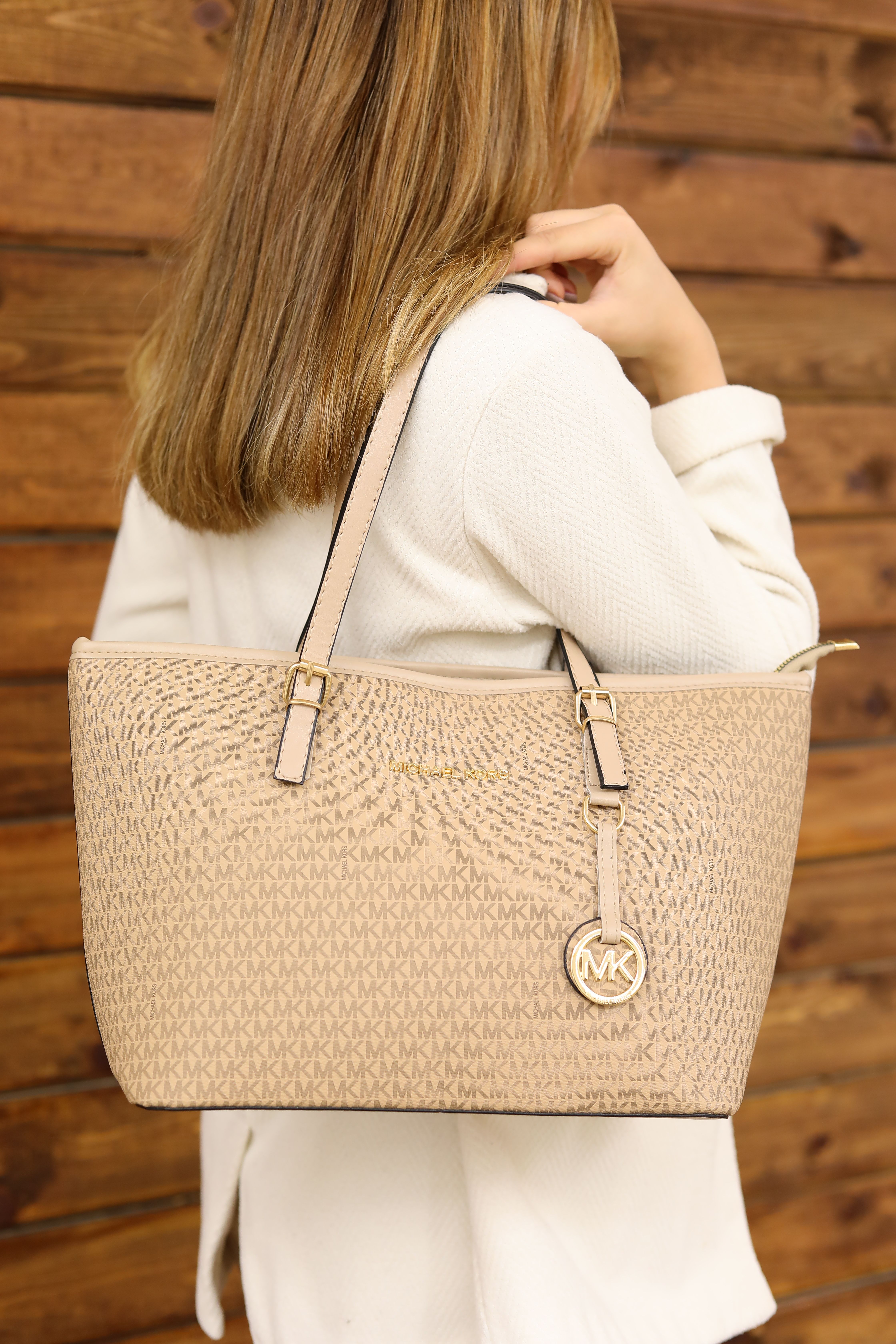
Running the Checks in Order
Where you buy matters as much as what you check, precisely because in-hand inspection is the only reliable method. There is no question to answer when you buy new from the brand’s own boutiques or established stockists such as Bergdorf Goodman, Neiman Marcus, Net-a-Porter, Mytheresa or Selfridges. Secondhand, the platforms that authenticate in hand — Rebag, The RealReal, Fashionphile, Vestiaire Collective — carry less risk than open marketplaces. Counterfeit reporting flags Poshmark and eBay as higher-risk venues for this label, which puts the burden back on you. The order below is the one worth following before any money changes hands. The table then summarises what each checkpoint looks like when it passes and fails.
- Make sure the model name actually exists and price-check it against that model, not the brand
- Examine stitching density and edge paint in close-up images or in hand
- Read the leather or suede for feel, grain and the way it takes light
- Track down both stamps and judge the interior one for crispness and centring
- Check the hardware for weight, finish and closure action, plus the engraving on the Margaux
- With the bag empty, confirm it stands up and holds its shape
- Let packaging corroborate, never decide, and purchase through a source that authenticates in hand
| Checkpoint | Reads correct when | Warning sign |
|---|---|---|
| Stitching | Even, unvarying density with no fraying | Drifting stitch lines, threads working loose |
| Painted edges | Evenly applied, no overflow | Bubbles or thin patches |
| Hide | Absorbs light, substantial yet soft | Stiff, thin or faintly plasticky, reflective |
| Suede nap | Matte throughout, colour uniform | Patchiness, or a sheen that reads as plastic |
| The stamp outside | Sits low, reads small | Prominent, oversized or set too high |
| The stamp inside | Crisp and centred, logo with Made in Italy | Blurred, crooked or off-centre |
| Hardware | Weighty, matte or brushed, moving precisely | Light and mirror-bright, rough or gritty in action |
| Form and structure | Holds itself up empty, recovers its form | Slumped shape, corners gone, base sitting unevenly |